
Tagged: Tumor Microenvironment

New Antibody Removes Tregs to Boost Immune Response Against Cancer

“Treg play a deleterious role in the tumor microenvironment by suppressing anti-tumor effector T cells.”

Cancer is a disease caused by the uncontrolled growth of cells that escape the body’s natural defenses. One way cancer protects itself is by taking advantage of certain immune cells called regulatory T cells, or Tregs. Normally, Tregs help prevent autoimmune diseases by controlling the immune system. But inside tumors, they behave differently. Instead of defending the body, they suppress the immune cells that could attack the cancer.

Many cancer treatments aim to activate the immune system to fight tumors more effectively. However, the presence of Tregs within the tumor makes this difficult. These cells act like bodyguards for the cancer, blocking the immune response that might otherwise slow or stop tumor growth.

Researchers have tried to eliminate Tregs by targeting a protein called CD25, found on their surface. However, earlier efforts often failed because these treatments also interfere with interleukin-2 (IL-2), a molecule that is essential for other immune cells to function. Blocking IL-2 weakens the entire immune response, limiting the treatment’s effectiveness.

To overcome this challenge, scientists recently developed a new antibody called 2B010. This study, titled A novel anti-human CD25 mAb with preferential reactivity to activated T regulatory cells depletes them from the tumor microenvironment,” was published in Oncotarget (Volume 16)

The Study: Finding a New Antibody Against Tumor Tregs

To develop a more selective tool for targeting Tregs, researchers from the National Institute of Allergy and Infectious Diseases, in collaboration with Boehringer Ingelheim and led by Maja Buszko and Ethan M. Shevach, conducted an experiment using mice. The animals were exposed to human regulatory T cells that had been activated and expanded in the laboratory. This exposure triggered the mice’s immune systems to produce antibodies against the Tregs. Among the resulting hybridomas, one named 2B010 stood out for producing an antibody capable of binding to CD25, a protein commonly found on the surface of active Tregs.

The Results: 2B010 Shows Selective Treg Depletion and Immune Activation

The 2B010 antibody was effective in both cell-based and animal studies. It was able to detect and remove regulatory T cells that were actively protecting tumors, without disrupting IL-2 signaling. This allowed the rest of the immune system to stay functional. 

In a mouse model of human breast cancer, treatment with 2B010 significantly reduced the number of Tregs inside the tumors. As a result, CD8+ T cells, which are responsible for killing cancer cells, became more active. While the tumors themselves did not shrink, the immune system clearly showed signs of stronger activity against the cancer.

What makes 2B010 different is its ability to distinguish between harmful and helpful immune cells. Although many immune cells express CD25 when activated, 2B010 preferentially binds to highly active Tregs within the tumor. This selectivity allows it to target only the cells that shield tumors, while sparing other important parts of the immune system.

The effect of 2B010 was not limited to the tumor site. Increased immune activity was also observed in the spleen, suggesting that this antibody may help support the body’s general immune response.

The Impact: Potential Role of 2B010 in Enhancing Cancer Immunotherapy

This discovery offers a potential direction for advancing cancer treatment. By removing the regulatory T cells that shield tumors from immune attack, the 2B010 antibody could improve the effectiveness of current immunotherapies. It may be particularly valuable when used alongside checkpoint inhibitors, drugs that help lift the immune system’s natural brakes. Together, these therapies could produce a stronger, more sustained anti-tumor response.

Since high levels of Tregs are linked to poor outcomes in many types of cancer, selectively eliminating these cells may help overcome a major obstacle in immunotherapy. In addition, because 2B010 does not interfere with IL-2 signaling, it may avoid the unintended side effects seen with earlier anti-CD25 antibodies. Together, these features make it a good candidate for more precise and better-tolerated cancer treatments.

Future Perspectives and Conclusion

While the 2B010 antibody shows strong potential in preclinical studies, its performance in human patients remains to be seen. Clinical trials will be essential to assess its safety, effectiveness, and compatibility with current cancer treatments. Researchers suggest that, with further development, 2B010 may become a valuable addition to combination immunotherapy strategies in the future.

Click here to read the full research paper published by Oncotarget.

_______

Oncotarget is an open-access, peer-reviewed journal that has published primarily oncology-focused research papers since 2010. These papers are available to readers (at no cost and free of subscription barriers) in a continuous publishing format at Oncotarget.com

Oncotarget is indexed and archived by PubMed/Medline, PubMed Central, Scopus, EMBASE, META (Chan Zuckerberg Initiative) (2018-2022), and Dimensions (Digital Science).

Click here to subscribe to Oncotarget publication updates.

For media inquiries, please contact media@impactjournals.com.
Trending with Impact: Crosstalk In the Tumor Microenvironment

Authors of this review paper discuss the complex crosstalk between cancer stem cells and macrophages, and potential anti-cancer strategies for future studies.

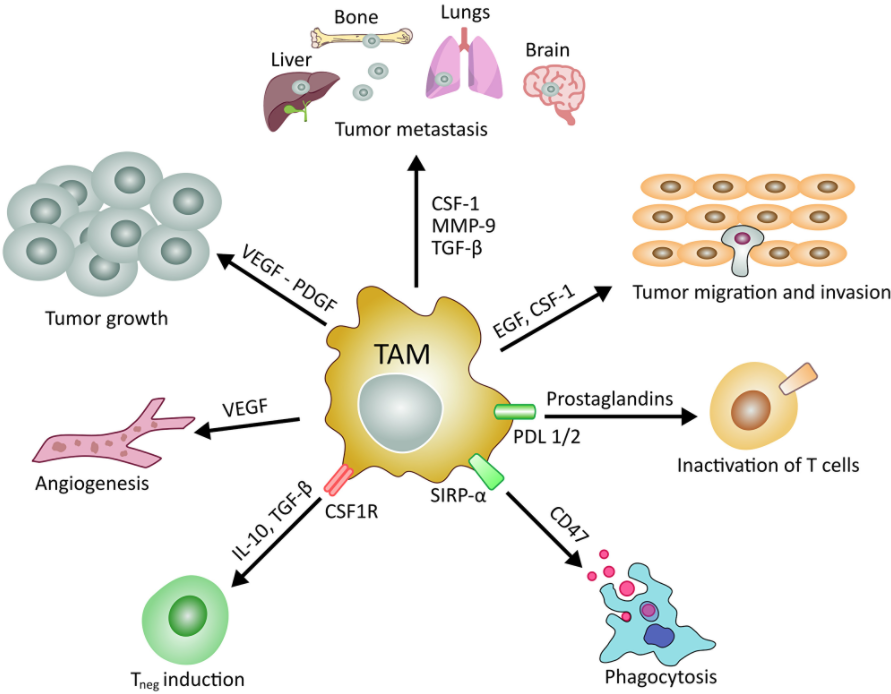
Figure 1: Main roles of tumor associated macrophages in cancer development and maintenance.
Figure 1: Main roles of tumor associated macrophages in cancer development and maintenance.

The Trending with Impact series highlights Oncotarget publications attracting higher visibility among readers around the world online, in the news, and on social media—beyond normal readership levels. Look for future science news and articles about the latest trending publications here, and at Oncotarget.com.

Listen to an audio version of the article

A review paper published by researchers from the University of Modena and Reggio Emilia in Italy and the Sulaiman AlRajhi Medical School in Saudi Arabia is trending and titled, “Cancer stem cells and macrophages: molecular connections and future perspectives against cancer.” 

“The aim of this review is to define the complex crosstalk between these two cell types and to highlight potential future anti-cancer strategies,” Dr. Beatrice Aramini said, a thoracic surgeon and scientist from the University Hospital of Modena Reggio Emilia.

There have been numerous studies published over recent decades in an effort to understand the molecular mediators of cancer stem cells (CSCs) and tumor associated macrophages (TAMs). Several studies have contributed to bringing light to some of the complex crosstalk that occurs between these two cell types and within the tumor microenvironment. The authors of this review paper reference hundreds of studies and offer a thorough audit and analysis of the current state of this research.

About the Writers of the Review Article

“I mainly focus on lung cancer,” Dr. Aramini said. “I started this project about cancer stem cells in lung cancer since 2017, at University Hospital of Modena Reggio Emilia, joining the laboratory of cell therapies directed by Professor Massimo Dominici with the chief of medical oncology at University Hospital in Modena.”

Dr. Valentina Masciale, co-author, is a research fellow at the University Hospital of Modena Reggio Emilia. Dr. Masciale’s professional experience began by studying missing stroma cells. She then studied stem cells in regenerative medicine and currently she is working with Dr. Aramini on a project focused on lung cancer stem cells. The paper they wrote was revised and approved by seven other contributing authors.

“In this review, we describe the importance of cancer stem cells as the key drivers of cancer initiation and progression due to their unlimited cell renewal capacity and their ability to induce tumor formation,” Dr. Aramini said.

Introduction to Cancer Stem Cells

“Cancer stem cells (CSCs) constitute a cancer cell subpopulation similar to the other stem cell types in terms of self-renewal and multilineage differentiation potential but drive tumor development besides heterogeneity and dissemination of cancer cells [19].”

In 1997, Bonnet and Dick were the first researchers to report the existence of cancer stem cells in the tumor, in acute myeloid leukaemia. Since then, however, a standard marker to identify CSCs still has yet to be found. 

“One of the main obstacles to proving the CSC model is the difficulty in identification and isolation of these cells [73391].”

The authors explain that one of the problems with finding a marker such as this is that many markers found are not only able to detect CSCs, but they also detect non-tumor cells. This represents a major obstacle when developing new therapies to target CSCs only. The authors note that recently there have been several gene markers described by researchers for CSCs in different tumors, including brainbreastblood, and lung.

“Indeed, there are currently no markers able to distinguish between stem cells and CSCs. Thus far, the best markers identified are those of onco-fetal stem cells, which are absent in adult organs and present in cancer cells [4548].”

Theories About the Role of Cancer Stem Cells

This review refers to a few theories about the role of CSCs in cancer progression. One theory is based on the premise that tumor tissue is hierarchically organized into different types of cells, with the CSC subpopulation as the top of this hierarchy. In this theory, the other levels consist of additional differentiated tumor cells or cells with a limited proliferative potential. The “clonal evolution theory” hypothesizes that a rampant mutating cell is the catalyst for tumor progression. 

“Peter Nowell was the first to describe the ‘clonal evolution theory,’ defining cancer as a complex process resulting from the development of a single out-of-control cell with multiple cell mutations that result in the progression of the tumor, which is kept viable through the selection of the most aggressive clones [89].” 

Since the discovery of CSC plasticity and the possibility of switching from stem to non-stem cells, researchers have gained a more complex picture of the origin of tumor heterogeneity and more theories about the role of cancer stem cells in tumor progression.

“An opposing theory is based on the concept that CSCs are a group of cells endowed with a high self-renewal capacity that can set different phenotypes of tumorigenic cells [1888].” 

Cancer Stem Cells and Macrophages

The researchers explain that macrophages are large specialized phagocytic cells that exist in tissues or at infection sites which act as part of the immune system. Arising from the bone marrow, macrophages perform multiple functions and roles in normal and tumor microenvironments, including pro-inflammatory activities and anti-inflammatory processes. Tumor-associated macrophages (TAM) comprise up to 50% of the tumor mass and have a close relationship with CSCs.

“The rising interest on these type of cells comes from recent study demonstrating that high number of tumor-associated macrophages correlate with the poor clinical prognosis in many solid tumors, including lung cancer, which is the field of our research group at the University Hospital of Modena,” Dr. Masciale said. “Another important aspect is the protective role of the tumor-associated macrophages play on tumors undergoing chemotherapy, which may impact the chemotherapy resistance and consequent tumor relapse.”

In recent studies, high numbers of TAMs in lung tumors, gastric cancer, and other cancer types, have been shown to correlate with a poor clinical prognosis. Macrophages are recruited to the tumor and, through crosstalk, provide protection to the tumor, contribute to immunosuppression in the tumor microenvironment and, eventually, drug resistance.

“The primary cause of failure in cancer treatment is the emergence of drug resistance that promotes the tumor spreading,” Dr. Masciale said.

“Cross-talk between CSCs and TAMs involves the recruitment of TAMs through vascularization and the release of chemokines by TAMs to preserve the quiescence of CSCs and modification of their antigens to escape from recruitment by immune cells.”

Future Perspectives

“Although most TAM-targeting strategies are in the pre-clinical stages, several factors used for TAMs depletion have already been tested in clinical trials [271272].”

Current efforts are underway to reprogram or inhibit the tumor-protective properties of tumor associated macrophages. Researchers are also investigating potential strategies to increase the efficacy of chemotherapy through nano-drug delivery to TAMs.

“Due to the significance of the tasks in which TAMs are involved, TAMs are increasingly becoming principal targets of novel therapeutic approaches, especially in the field of nanomedicine.”

The authors believe that targeting TAMs could trigger various reactions in the tumor, which are difficult to predict even given the individual variability from patient to patient. They also explain that targeting TAMs with CSCs offers another potential for treating different tumors to better control cancer progression and avoid tumor dissemination. 

“In summary, generating new information about the interaction between TAMs and CSCs will be one of the most important challenges for the development of more effective targeted cancer therapies.”

Click here to read the full scientific review, published in Oncotarget.

Click here to read or watch an interview with the authors Behind the Study.

Oncotarget is a unique platform designed to house scientific studies in a journal format that is available for anyone to read—without a paywall making access more difficult. This means information that has the potential to benefit our societies from the inside out can be shared with friends, neighbors, colleagues and other researchers, far and wide.

For media inquiries, please contact media@impactjournals.com.